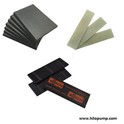
As a supplier of carbon fiber vanes, I've been constantly exploring the diverse applications of this remarkable material. One question that often arises is whether carbon fiber vanes can be used in agricultural machinery. In this blog, I'll delve into the properties of carbon fiber vanes, the requirements of agricultural machinery, and analyze the feasibility of their application in this field.
Properties of Carbon Fiber Vanes
Carbon fiber is a high - performance material known for its exceptional properties. First and foremost, it has an extremely high strength - to - weight ratio. Compared to traditional metal materials, carbon fiber can provide the same or even greater strength while being significantly lighter. This characteristic is crucial as it can reduce the overall weight of the machinery, leading to less energy consumption during operation.
Another important property is its corrosion resistance. Carbon fiber is highly resistant to various chemicals and environmental factors. In agricultural settings, machinery is often exposed to fertilizers, pesticides, and moisture. These substances can cause corrosion to metal components over time, leading to reduced performance and a shorter lifespan. Carbon fiber vanes, on the other hand, can withstand such harsh conditions, ensuring long - term reliability.
Carbon fiber also has excellent fatigue resistance. Agricultural machinery often operates under repetitive stress. For example, the blades of a harvester or the vanes in a ventilation system of a greenhouse are constantly in motion. The ability of carbon fiber to resist fatigue means that it can maintain its structural integrity over a large number of cycles, reducing the need for frequent replacements.


Requirements of Agricultural Machinery
Agricultural machinery has a wide range of requirements depending on its specific function. For instance, tractors need to be powerful and durable to pull heavy loads and work in rough terrains. Harvesters require sharp and efficient cutting components to ensure a high - quality harvest. Greenhouse ventilation systems need reliable and efficient air - moving parts to maintain proper temperature and humidity.
In addition to performance, cost - effectiveness is also a key consideration. Farmers and agricultural businesses operate on tight budgets, so the cost of purchasing and maintaining machinery is an important factor. The machinery should also be easy to maintain and repair to minimize downtime during the busy farming seasons.
Feasibility of Using Carbon Fiber Vanes in Agricultural Machinery
Advantages
- Improved Efficiency: The lightweight nature of carbon fiber vanes can enhance the efficiency of agricultural machinery. For example, in a ventilation system of a greenhouse, lighter vanes require less energy to rotate, which can lead to significant energy savings over time. In a harvesting machine, reducing the weight of certain components can improve the overall maneuverability and speed of the machine.
- Longer Lifespan: Due to their corrosion and fatigue resistance, carbon fiber vanes can last longer than traditional metal vanes. This reduces the frequency of replacements, saving both time and money for farmers. For example, in a pesticide - spraying machine, the vanes are in contact with corrosive chemicals. Carbon fiber vanes can withstand these chemicals better, ensuring continuous and reliable operation.
- Enhanced Performance: Carbon fiber vanes can be designed to have precise aerodynamic shapes, which can improve the performance of air - moving components in agricultural machinery. In a wind - powered seed spreader, well - designed carbon fiber vanes can ensure a more even distribution of seeds, leading to better crop yields.
Challenges
- High Initial Cost: One of the main challenges of using carbon fiber vanes in agricultural machinery is the high initial cost. The production process of carbon fiber is complex and requires specialized equipment, which makes the price of carbon fiber vanes relatively high compared to traditional metal vanes. This may be a deterrent for some farmers and agricultural businesses with limited budgets.
- Repair Difficulty: Although carbon fiber has many advantages, repairing damaged carbon fiber components can be more difficult than metal components. Specialized skills and equipment are required for carbon fiber repair, which may not be readily available in rural agricultural areas.
Case Studies
There have been some successful applications of carbon fiber in related fields that give us an indication of its potential in agricultural machinery. In the aerospace industry, carbon fiber is widely used due to its lightweight and high - strength properties. For example, the wings of some modern aircraft are made of carbon fiber composites, which significantly reduce the weight of the aircraft and improve fuel efficiency.
In the automotive industry, high - performance cars often use carbon fiber components to enhance performance. These experiences show that if the cost and repair issues can be addressed, carbon fiber vanes can have a bright future in agricultural machinery.
Related Products for Agricultural Machinery
In addition to carbon fiber vanes, there are other important parts for agricultural machinery, especially those related to vacuum pumps. For example, the Coupling & Coupling Sleeve for Busch Vacuum Pump is an essential component for ensuring the proper connection and transmission of power in a vacuum pump system. The Heat Sink Radiator for Busch Pump RA0100 160 202 250 302 helps to dissipate heat generated during the operation of the pump, ensuring its stable performance. And the Check Valve Exhaust Valve for Busch Vacuum Pump is crucial for controlling the flow of air and preventing back - flow in the pump system.
Conclusion
In conclusion, carbon fiber vanes have great potential for use in agricultural machinery. Their high strength - to - weight ratio, corrosion resistance, and fatigue resistance offer many advantages in terms of efficiency, lifespan, and performance. However, the high initial cost and repair difficulty are significant challenges that need to be overcome.
As a supplier of carbon fiber vanes, I am committed to working with agricultural machinery manufacturers and farmers to find solutions to these challenges. We are constantly researching and developing new production techniques to reduce the cost of carbon fiber vanes. At the same time, we are also exploring ways to simplify the repair process and provide training and support for farmers.
If you are interested in learning more about carbon fiber vanes for your agricultural machinery or have any questions regarding their application, I encourage you to reach out to me for further discussion and potential procurement negotiations. Let's work together to bring the benefits of carbon fiber technology to the agricultural industry.
References
- Ashby, M. F. (2005). Materials selection in mechanical design. Butterworth - Heinemann.
- Callister, W. D., & Rethwisch, D. G. (2011). Materials science and engineering: An introduction. Wiley.
- Gibson, R. F. (2012). Principles of composite material mechanics. CRC Press.